


Design Thinking Concept
Design Thinking is a non-linear process used by teams to understand user needs, challenge assumptions, redefine problems, and create innovative solutions for prototyping and testing.
David Kelley developed the Design Thinking concept and began promoting it in various business areas, including marketing. To bring a product to life that is compatible with the needs of the target audience, you need to listen, create, and, last but not least, deliver.
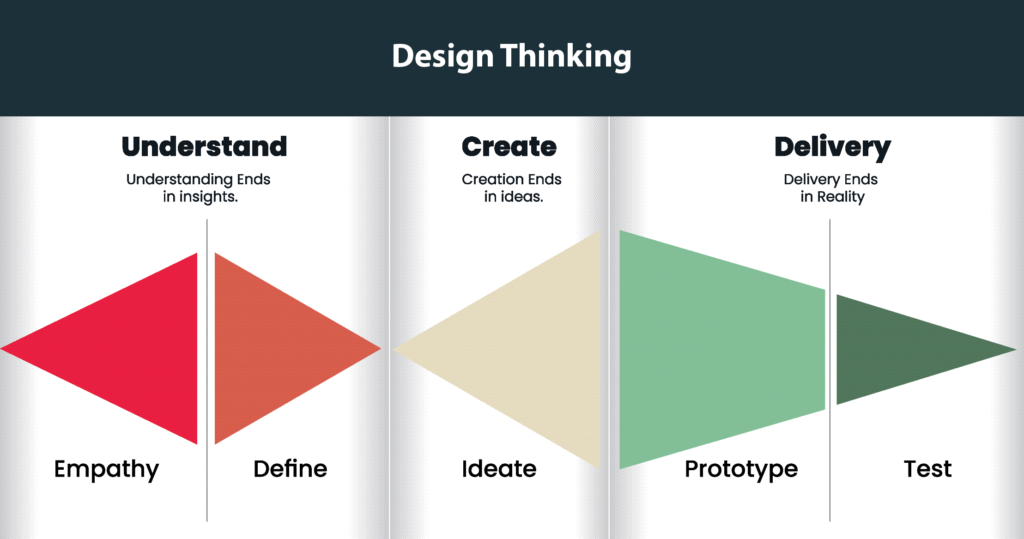
The Design Thinking process involves five strict stages:
- Empathize (Understand the target audience)
- Define (Build a viewpoint based on their needs)
- Ideate (Brainstorming and finding creative solutions)
- Prototype (Building representations of ideas)
- Test (Implementing ideas and receiving feedback)
In UX, it is crucial to have skills to understand and address the rapid changes in user behaviors. Design Thinking has evolved over time, and professionals and engineers have creatively used it to meet human needs in the modern era since cognitive scientist and Nobel laureate Herbert A. Simon first mentioned the concept in 1969. Design teams use this concept to address unknown problems by reframing them in user-centered ways, focusing on what is necessary for the user. Among all design processes, Design Thinking is certainly the best because teams can conduct more effective UX research, prototypes, and usability tests to discover new ways to meet customer needs. Additionally, using Design Thinking gives teams the freedom to generate innovative solutions.
As mentioned above, this concept is divided into five essential stages, which are not always sequential, and teams often run them in parallel. The following paragraphs describe each one in detail to better understand the basis of the concept.
1. Empathy (Meeting and observing those for whom you are designing)
Whether you need to create a pleasant experience for your audience or a digital tool, in the first phase, you must understand reality, not make assumptions. This stage is essential, yet many skip it because they believe it slows them down or that statistics are more critical than conversations with users. Designers should put themselves in the shoes of the client to truly connect with them on a deeper level.
2. Define
In this stage, you need to reach a central point of interest after going through the first stage and figure out what truly matters to your target audience. Here, you must find solutions to one of the most critical challenges.
3. Ideate (Generate a Possible Solution)
When you reach this stage, ideas start to flow like a river in the form of questions followed by solutions. All of this is done through brainstorming sessions to generate the most commendable ideas, which are then put into practice.
4. Prototype
A prototype is an object you create from any material you have to convey the idea of the product. Models can be made from paper tools, rolls, pencils, so that the ideas seem real and the client can easily understand them.
5. Test
Testing through Design Thinking means receiving feedback about the prototype. Asking for and receiving feedback is essential to successfully complete this stage.
In conclusion, Design Thinking promises in numerous fields because it brings humanity to its core, not technology, not profit, but people and their emotions. This concept also helps us be collaborative, build on each other’s ideas, and work together with professionals.
- Written by: BeSoftwares
- Posted on: September 17, 2021
- Tags: Design Thinking, Mobile Development, Web Development